
Palazzo Strozzi stands as one of the most perfect examples of Florentine Renaissance architecture. Imposing yet measured, elegant in its restraint, it dominates the square that bears its name with a presence that doesn’t need any emphasis. The building, entirely clad in pietra forte stone, stands out for the harmony of its proportions and the geometric purity of its lines.
The façade unfolds over three superimposed levels, marked by horizontal string courses that lighten its monumental structure. Each floor features rusticated stonework finished in a different way… rougher and more powerful at the base, gradually smoother as you go up, until it reaches the perfectly even surface of the top floor. This gradual shift from strength to lightness gives the palace a sense of visual ascent, as if the material itself were becoming purer.
The windows are framed by understated mouldings and projecting sills that catch the light evenly, highlighting the geometric precision of the whole. The overall effect is one of great harmony, free of decorative excess yet rich in balance and proportion.
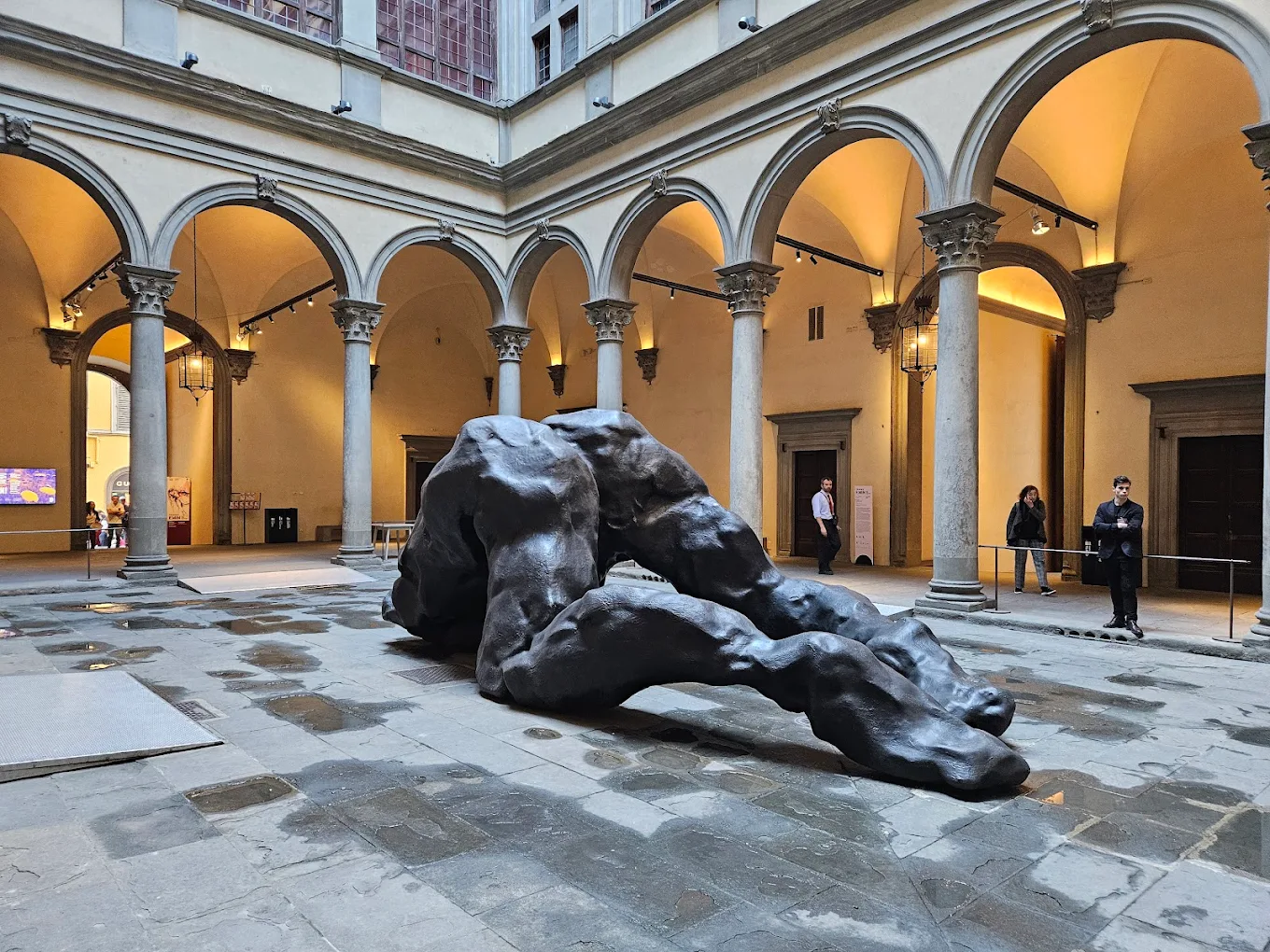
The main entrance leads into a square courtyard, considered one of the most elegant of the Renaissance. Here pietra serena replaces pietra forte, creating a subtle colour contrast that helps make the space bright and airy. A portico runs all around the perimeter, supported by slender Corinthian columns topped with full semicircular arches. The regular rhythm of these arches generates a sequence of perspectives that changes with the daylight. In the morning, cooler tones of the stone prevail, while in the afternoon the sun brings out its golden reflections.
At the centre of the courtyard stands an old wrought-iron well, simple and well proportioned, which acts as a visual focal point and recalls the original function of the space as a place of daily life and meeting. Today, this area—freely open to the public—is often animated by art installations and temporary events that fit discreetly into the architectural harmony.
From the side staircases you reach the upper floors. The main staircase, built in pietra serena, stands out for the width of its steps and the gentle incline that makes the ascent feel natural and almost solemn. Along the way, light filters through the side windows and accompanies visitors towards the Piano Nobile, the representative heart of the building. The rooms on this floor still preserve their wooden coffered ceilings, large windows and the understated elegance of the original mouldings. The surfaces are simple, but the layout of the rooms and the balance between solid walls and openings create a perfect sense of proportion.
These spaces now host the temporary exhibitions organised by the Fondazione Palazzo Strozzi, which continues to use the historic interiors while respecting their architectural identity. Smooth walls, terracotta floors and natural light create an ideal setting for displaying artworks from different eras, from Renaissance paintings to contemporary installations.
In the underground level lies the Strozzina, a hypogean space originally used as storage and cellars. Its stone vaults and intimate rooms have been carefully restored and today host contemporary art shows, performances and multimedia installations. The intimate atmosphere and the dialogue between the ancient stonework and modern works make the visit a special experience, capable of uniting past and present in a single path.
Palazzo Strozzi doesn’t impress through opulence but through its formal perfection. Every element, from the placement of the windows to the pattern of the rustication, follows a logic of balance that reflects the Renaissance idea of the human being as the measure of all things. Even today, more than five centuries later, Palazzo Strozzi remains a point of reference for the city of Florence. Its original layout, almost entirely preserved, testifies to the incredibly high technical and artistic level reached by Renaissance architects. It is a building that combines strength and grace, rigour and light, and that encapsulates the very essence of humanist Florence: a perfect balance between art, proportion and beauty.
When the setting sun colours the façade with warm shades and the courtyard fills with silence, Palazzo Strozzi reveals its true nature: not just an architectural masterpiece, but a living lesson in timeless harmony.