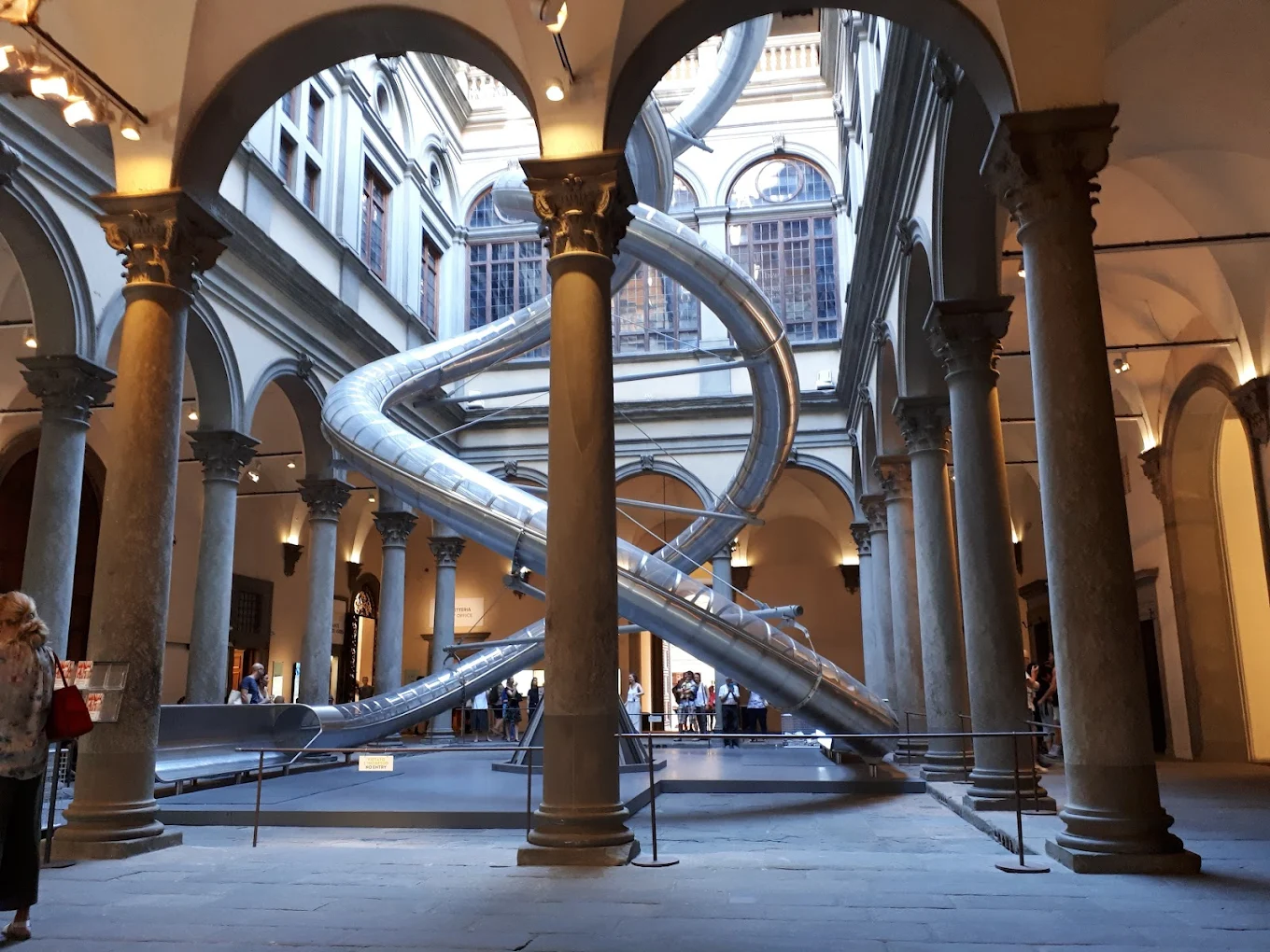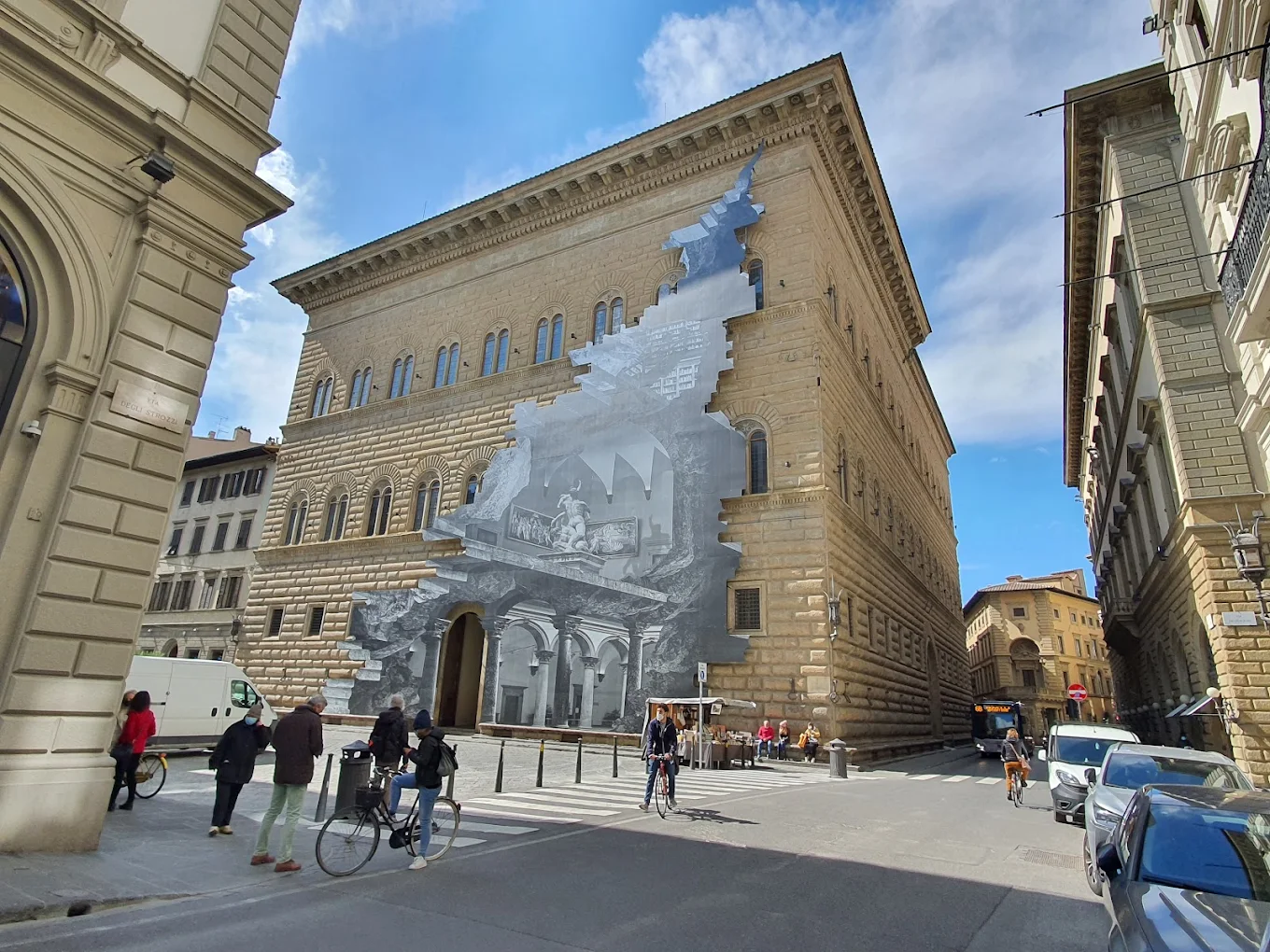

The inner courtyard of Palazzo Strozzi is one of those places that feel suspended in time. As soon as you step through the imposing portal on Via Strozzi, you’re greeted by a silence that seems almost impossible in the beating heart of Florence. Far from the buzz of tourists and the sounds of the shopping streets, the courtyard opens up like a breath of stone and light: perfectly proportioned, harmonious, rigorously elegant in its Renaissance style.
The first impression is one of absolute balance. Every line, every arch, every column seems placed with a precision that leaves no room for chance. It’s the Renaissance ideal translated into architecture: beauty as measure, geometry as poetry. The courtyard was designed by Benedetto da Maiano at the end of the fifteenth century, inspired by the forms developed by Filippo Brunelleschi, the master of that Tuscan harmony that still defines Florence today.
Light slides along the pietra serena walls, bounces off the arches and draws soft reflections across the stone paving. It’s a light that changes over the course of the day, creating different moods: in the morning, clear and direct, it highlights the perfection of the arcades; in the afternoon, warm and golden, it wraps the space in an almost sacred calm. Standing at the centre of the courtyard, you can feel the mathematical precision with which it was conceived: a perfect square, framed by loggias on three sides and by a portico opening inward.
The slender, evenly spaced columns support finely carved Corinthian capitals. Above them, a continuous frieze runs along the entire perimeter, marking with steady rhythm the transition between the ground floor and the upper level. The first-floor windows, framed by elegant mouldings, look out like discreet eyes, while the Strozzi family coat of arms, carved in several places, recalls the power and wealth of one of the most influential dynasties of the Florentine Renaissance.
It’s easy to imagine the bustle of servants and horsemen, meetings between merchants, conversations between humanists and artists. Every stone seems to hold a fragment of that refined yet austere daily life that animated patrician palaces in the fifteenth century. Today, the space welcomes contemporary art exhibitions, installations and performances that dialogue with the strict geometry of the ancient architecture, creating a striking contrast that still feels perfectly in tune with the spirit of Florence — a city that has been weaving together past and innovation for centuries.
At the centre of the courtyard there is often a temporary installation: a sculpture, a light structure, or sometimes just an ephemeral fountain playing with water reflections. This ever-changing element constantly renews the perception of the space, as if the palace itself were breathing through the works that inhabit it. It’s one of the best examples of how a historic site can remain alive — not as a relic, but as a stage for dialogue between eras.
The acoustics of the courtyard are surprisingly vivid. Footsteps ring out sharp and clear, while voices bounce off the smooth surfaces, creating a light, pleasant echo. In certain moments, when the flow of visitors thins out, you can even sense the distant heartbeat of the city, like an external call reaching in, softened by the walls. Many travellers remember this feeling: being right in the centre of Florence and, at the same time, somewhere else entirely, in a suspended elsewhere.
Seen from different angles, the courtyard reveals the perfect perspective that Renaissance masters pursued so obsessively. Your gaze is naturally drawn toward the centre, as if the space itself were designed to encourage contemplation. It’s not just architecture, but an exercise in harmony — a balance between measure and wonder.
Visiting the inner courtyard of Palazzo Strozzi means stepping into a microcosm where stone speaks with a human voice. The courtyard is not just a passageway to the exhibitions or a prelude to the rooms inside: it is an experience in its own right, a moment of suspension that perhaps more than anything else captures the spirit of Florence — a perfect balance between people, light and stone.